Written by Jackson Pearce Student engineer and creator of TalonTodo
I used to study by reading. I'd read the chapter, highlight the important parts, read my notes, and go into the exam feeling prepared. Then I'd sit down, and half the material would be gone. I'd studied for hours. I'd retained almost nothing.
The problem wasn't the amount of studying. It was the method. Reading feels like learning. Highlighting feels like learning. They aren't, or at least not effectively. The brain learns by being tested, not by being exposed to information.
Once I switched to evidence-based study techniques, my grades went up and my study time went down. Here's what actually works.
Why Most Studying Doesn't Work
Before the techniques, it's worth understanding why the common ones fail.
The Fluency Illusion
Re-reading material feels productive. The words become familiar. You recognize them. You think you know the material because you've seen it multiple times.
But recognition is not recall. Seeing something feels like knowing it. Actually knowing it means you can produce it from memory without prompts. The test is a recall task. Re-reading trains recognition. That's why it fails.
Highlighting Is Passive
Highlighting creates the feeling of engagement without the reality of it. You're not processing the material—you're just marking it. Then you re-read the highlighted sections, which takes you back to the recognition-not-recall problem.
Use highlighting sparingly, only to mark passages you'll revisit for active processing. Don't mistake the act of highlighting for the act of learning.
Cramming Is Leaky
Cramming the night before an exam works—for about 48 hours. The brain consolidates information through sleep and spaced repetition. When you cram, you're dumping information into short-term memory. It's there for the exam. Then it's gone.
If your goal is to actually learn the material—to understand a subject, to retain it for future courses, to build expertise—cramming is worse than useless.
Techniques That Are Supported by Evidence
These are techniques that have been repeatedly tested in research and consistently shown to improve learning outcomes.
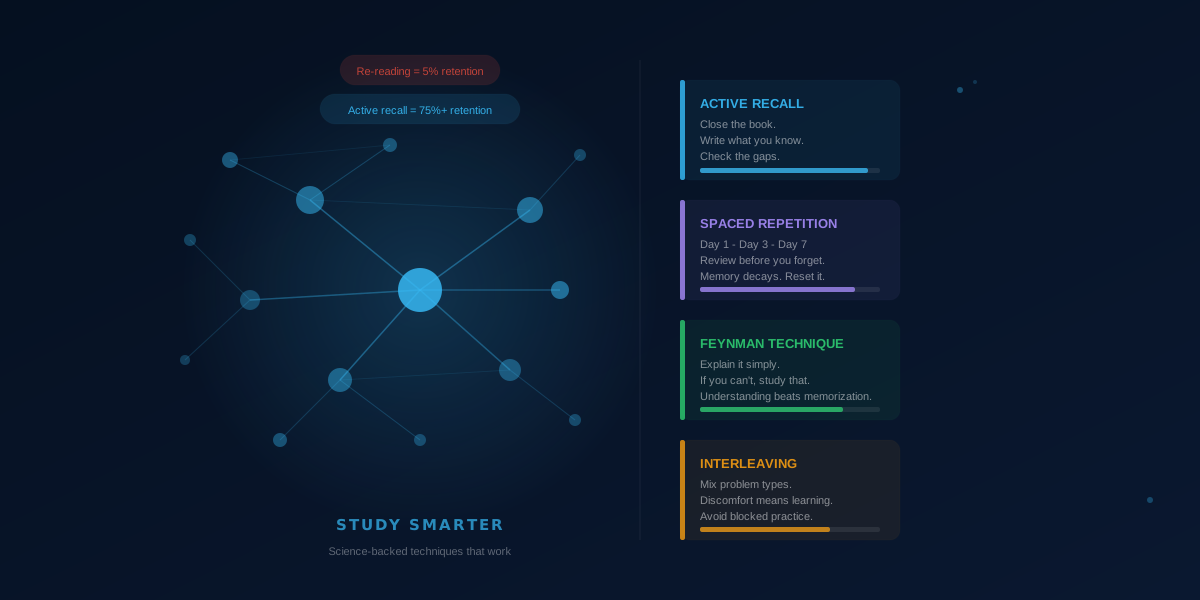
Active Recall
Instead of re-reading your notes, close them and try to write down everything you can remember. Then check what you missed.
This is the single most effective study technique. The act of trying to retrieve information strengthens the neural pathways that store it. Every retrieval attempt makes the next retrieval easier. Every re-read does not.
How to use it:
- Read a section, then close the book and write down the key points from memory
- Use flashcards (Anki is excellent for this)
- After a lecture, write a summary from memory before looking at your notes
- Practice problems, not just reading about concepts
The retrieval doesn't have to be perfect. The attempt is what matters. Failing to recall something and then checking the answer produces stronger learning than reading the answer passively.
Spaced Repetition
Spaced repetition means reviewing material at increasing intervals over time, rather than all at once.
Your memory decays at a predictable rate. If you review material just before you'd forget it, you reset the decay clock and the next interval before decay is longer. Review at the right intervals and material moves from short-term to long-term memory efficiently.
In practice: review new material the same day you learn it, then the next day, then three days later, then a week, then two weeks. Apps like Anki do this automatically—they track which material you're about to forget and show it to you at the optimal time.
This is why cramming fails. You learn everything at once, review it at once, and the decay hits everything simultaneously. Spaced review prevents that.
The Feynman Technique
Named after physicist Richard Feynman, this technique is simple: explain the concept in plain language as if teaching it to someone who knows nothing about it.
When you can explain something simply, you understand it. When you can't, you find the exact gaps in your understanding. Those gaps are what to study next.
How to use it:
- Pick a concept
- Explain it in plain language, out loud or on paper
- Notice where you struggle, use jargon, or get vague
- Go back to your source material and study those specific gaps
- Repeat until you can explain the whole thing clearly
This is especially useful for conceptual material—sciences, economics, philosophy—where it's easy to feel like you understand something because you've read about it without actually being able to use it.
Interleaving
Most students practice one type of problem until they have it down, then move to the next. This feels productive but produces worse results than mixing problem types.
Interleaving means mixing different types of problems in a single study session. Instead of doing 20 algebra problems then 20 geometry problems, you alternate between them.
Interleaving is harder and feels less efficient. It is harder. That difficulty is the mechanism—the brain works harder to retrieve the right approach for each problem, which strengthens retention. Studies consistently show interleaved practice produces better long-term performance than blocked practice, even though blocked practice feels more comfortable.
Elaborative Interrogation
Ask "why" and "how" rather than just accepting what you read. When you encounter a fact, ask: why is this true? How does it connect to what I already know? What would happen if this were different?
This technique forces you to connect new information to existing knowledge, which is how memory works. Information attached to other information is harder to forget than isolated facts.
It's also why context matters for learning. Facts learned in isolation are fragile. Facts embedded in explanations, causes, and connections are durable.
How to Structure a Study Session
Knowing the techniques is one thing. Using them consistently is another. Here's how to structure sessions for maximum effectiveness.
Set a Specific Goal Before You Start
Not "study chemistry." Instead: "Be able to answer 20 practice problems from chapter 8 without notes." Specific goals make it possible to know when you've succeeded and to evaluate whether your time was well spent.
I write my study session goal in TalonTodo before I start. When the session ends, I note whether I hit it. Over time this builds self-knowledge about how long different types of studying actually take.
Active Recall First
Start the session by retrieving what you already know. Before you open your notes, spend 5 minutes writing down everything you can remember about the topic. This activates what you know and makes the gaps visible—you'll see exactly what you need to work on.
Study, Then Test Yourself
Work through new material, then immediately test yourself on it. Don't move on until you can produce the key points from memory. This is slower than reading and moving on. It's also vastly more effective.
The right question is not "how much material did I cover?" It's "how much material can I now actually recall?" Those are very different numbers for most students.
End with a Memory Dump
At the end of a session, spend 5 minutes writing down everything you can recall from the session without looking at your notes. This is a final active recall pass and serves as a checkpoint: what stuck, and what needs more work?
Applying This to Different Subjects
Sciences and Math
These are practice subjects. Reading about how to solve problems doesn't teach you to solve them. The only way to learn math and science is to do problems—lots of them, without looking at solutions until you've genuinely attempted them.
Active recall here means practice problems. Spaced repetition means re-doing old problems over the days following when you first learned them. Interleaving means mixing problem types in each session.
Humanities and Social Sciences
These subjects have more conceptual content and require genuine understanding, not just memorization.
The Feynman Technique is especially valuable here. For each major concept or argument, practice explaining it simply. For essay-based subjects, practice writing on topics from memory—not outlining, writing.
Active recall looks different: explain the theory in your own words, argue for or against a position, compare two frameworks you've read about.
Languages
Spaced repetition is the core technique for vocabulary. Anki is built for this. Active recall means speaking and writing in the language, not just recognizing words when you see them.
For grammar, practice (not study) is primary. You learn language patterns by using them, not by reading about them.
Common Mistakes
Mixing Up Comfort and Effectiveness
The techniques that feel easiest—re-reading, highlighting, watching video explanations—are generally the least effective. The techniques that produce the most learning—practice problems, active recall, the Feynman technique—feel harder and more uncomfortable.
That discomfort is the learning. It's called desirable difficulty. If studying feels effortless, you're probably not learning much.
Confusing Time Spent with Learning Achieved
Six hours of passive re-reading produces less learning than two hours of active recall and practice problems. Track what you can do at the end of a session, not how long you sat at your desk.
Not Spacing Reviews
You learn something in lecture on Monday. You study it Monday night. You move on. Two weeks later you've forgotten most of it and have to re-learn it for the exam.
Schedule review sessions. In TalonTodo, I create recurring tasks for subjects I'm learning—a review session one day, three days, and one week after first learning something new. The review takes 15 minutes. It's the difference between lasting memory and perpetual re-learning.
How TalonTodo Supports Smarter Studying
Effective studying requires planning. The spaced repetition schedule, the practice session goals, the session tracking—none of this happens without some system to organize it.
Why I built it: I needed to track not just what I had to do, but what I needed to review and when. Most task apps let you write a task. I needed one that could schedule recurring reviews, track which subjects needed attention, and connect my study tasks to my broader academic goals.
How it helps: TalonTodo's class-based organization lets you attach tasks to specific courses. Recurring task creation makes it easy to schedule spaced review sessions. The calendar view shows your study blocks alongside your class schedule so you can see gaps and plan around deadlines.
Feature example: When I start a new topic in a class, I create a set of recurring review tasks automatically spaced at 1 day, 3 days, and 7 days out. This builds my spaced repetition schedule directly into my task system. I don't have to remember when to review—TalonTodo shows me what needs attention and when.
The Results
When I switched from passive re-reading to active recall and spaced repetition, three things happened:
- My exam grades improved, particularly on exams that tested application and synthesis rather than pure memorization
- My study time decreased because I wasn't covering the same material repeatedly
- I actually retained the material beyond the exam—I could still explain concepts from courses I'd taken the previous semester
Smarter studying isn't about working less. It's about working in ways that actually produce learning. The techniques are uncomfortable because they require effort. That effort is precisely what makes them work.
Start with one technique. Active recall is the most impactful and easiest to apply immediately. Close your notes and try to write down what you know. Notice the gaps. Study those. Repeat.
That's studying smarter.
Practice tests next to the homework
Cards without the week's due dates split your attention again. A Quizlet Alternative That Also Plans Homework covers the one-test limit on Quizlet's free tier and a study list that lives with the assignments.
About the author Jackson Pearce is a student engineer and the creator of TalonTodo, a productivity app designed to help students manage projects, deadlines, and daily tasks more effectively.